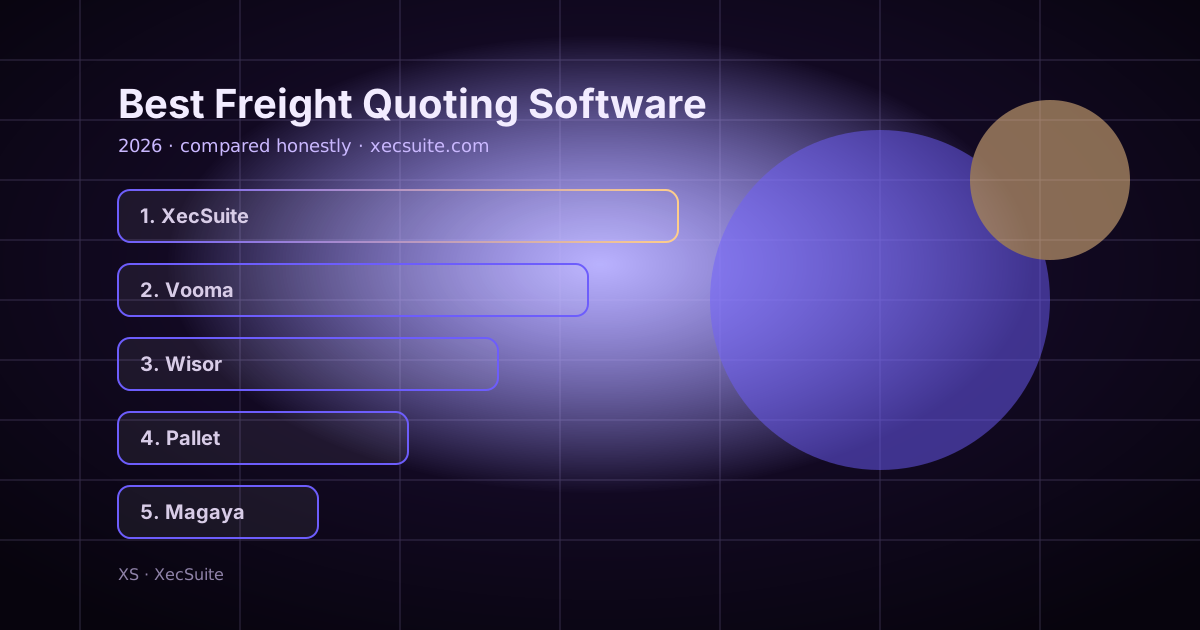
Best Freight Quoting Software for 3PLs and Brokers (2026)
Updated 2026-08-23 · By Nick Grossi · 7 min read
Five tools automate freight quoting in 2026, and they are not interchangeable. This guide says what each one does best, including our own, so you can match the tool to your operation instead of the loudest pitch.
Quote speed wins freight. Every tool on this list can read a quote request and cut your response time. The differences that matter sit underneath: what the tool knows about the lane, the customer, and the margin when it drafts the number, and who signs off before the quote leaves.
We build one of these tools. The list below covers the field as it stands in 2026, with each tool’s real strength stated plainly.
1. XecSuite
Best for: cross-border 3PLs that want quoting connected to lane history, margin, and approvals
XecSuite treats quoting as part of the whole operation, not a stand-alone inbox trick. Quote requests connect to CRM history, lane memory, margin signals, FX, customs, and dwell context, and every quote routes through an approval gate before it goes out. It is an operating layer above your TMS and email, not a point tool.
It fits teams that lose money on fast-but-blind quotes, and cross-border Canada–US operations where customs and FX eat margin quietly. If you only want raw quote turnaround speed and nothing else, a point tool below may be the simpler buy.
Quotes drafted with lane history and margin context attached
Human approval before anything goes outbound
Part of a governed operating layer: CRM, freight analysis, operations in the same memory
2. Vooma
Best for: high-volume brokers that want fast multi-channel quote automation
Vooma builds AI agents for brokers across email, text, and voice. Vooma Quote reads inbound requests and drafts responses, and the company reports it saves brokers around five minutes per quote. Named brokers on their site include Echo, MODE, and Arrive Logistics.
It is a strong, well-funded product with real traction in high-volume brokerage. Its center of gravity is the broker workflow itself; teams that also want lane profitability analysis or operations context in the same system will pair it with other tools.
3. Wisor
Best for: freight forwarders quoting complex multimodal shipments
Wisor positions itself as an AI revenue platform for freight forwarding. It centralizes carrier rates, automates rate management, and quotes complex multimodal moves, with an inbox agent that turns emailed requests into quotes.
Forwarders with ocean and air legs in the mix get the most from it. Domestic truckload brokers and 3PLs are not its core case.
4. Pallet
Best for: high volumes of spot quotes and RFPs
Pallet’s quoting product extracts lane and volume data from inbound requests and generates quotes in the format the customer asked for. It is built for brokers and 3PLs that live in spot-quote and RFP volume.
If your bottleneck is pure request-to-quote throughput, it is a focused answer to exactly that.
5. Magaya
Best for: teams already running the Magaya platform
Magaya’s quote automation receives requests, gathers rates, applies markups, and returns the quote; the company advertises about fifteen minutes saved per quote. It lives inside the Magaya ecosystem.
If Magaya is already your system of record, its native quoting is the path of least resistance. Outside that ecosystem, the integrated options above fit better.
How to choose
Start from your bottleneck, not the feature list.
Count the minutes from request to quote today, and how many quotes go out below your margin target. Speed tools fix the first number; context tools fix both.
Ask who approves a quote before it leaves. If the answer is nobody, decide whether you are comfortable with that at your volume.
Check what the tool knows about the lane when it drafts: history, margin, customs, FX. A fast wrong number is still wrong.
Cross-border operations should weigh customs and FX context heavily; pure domestic spot desks can weigh throughput.
Apply this to your 3PL
Want the operator version for your freight business?
Share your tool stack and the lane, decision, or workflow you are trying to fix. XecSuite will map the modules, agents, and workflow path that can produce measurable ROI.