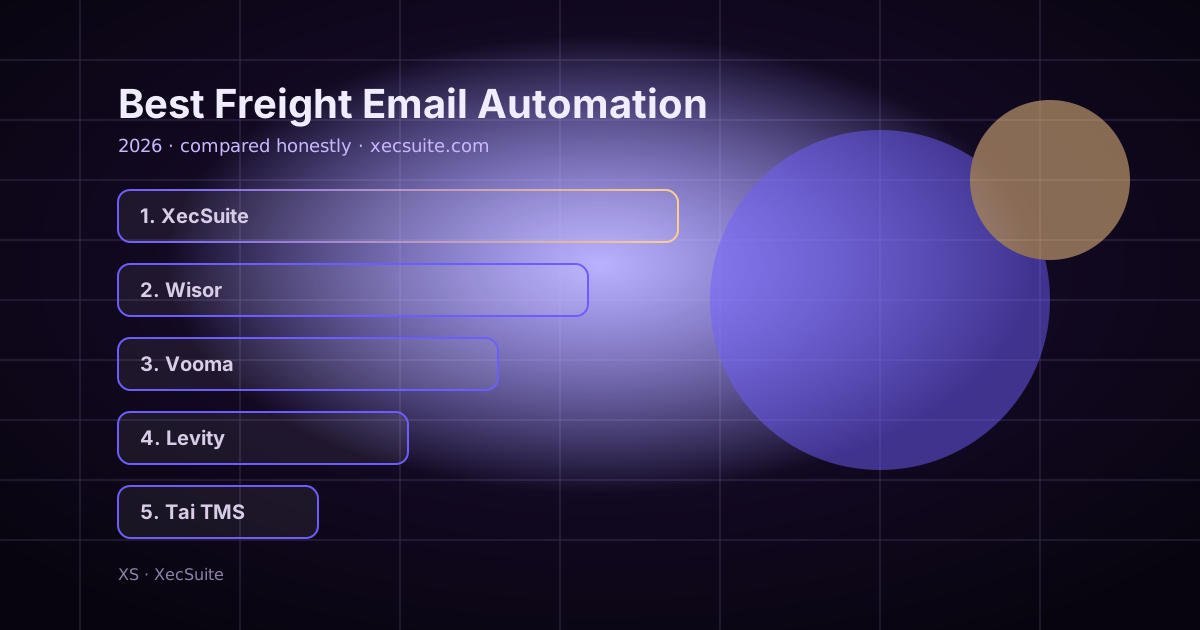
The freight inbox mixes quotes, bookings, tracking questions, and carrier updates in one stream. Five tools automate it in 2026. This guide says what each does best, including our own.
Every logistics company runs on email, and most of it is structured work wearing an unstructured costume: quote requests, booking confirmations, tracking questions, exceptions. Email automation software reads that stream, classifies it, and either drafts the response or routes the work.
The tools below take genuinely different approaches. Some are inbox point tools, some are TMS features, one is an operating layer. We build the last one.
1. XecSuite
Best for: 3PLs and forwarders that want the inbox wired into the whole operation
XecSuite classifies each inbound message, attaches customer and lane context from company memory, and routes it: quote requests toward quoting, exceptions toward operations, questions toward a drafted reply a person approves. Nothing goes outbound without a human sign-off.
It fits teams whose email problem is really a context problem: the reply depends on lane history, margin targets, and what that customer shipped last quarter. Teams that only want a faster inbox may find a point tool simpler. One honest limit: XecSuite works from message text and structured data; it does not read scanned documents or photos today.
Replies drafted with lane and customer context attached
Approval gates on everything outbound
2. Wisor
Best for: freight forwarders turning emailed requests into quotes
Wisor’s inbox agent integrates with Outlook and Gmail and turns emailed quote requests into priced responses, with a case study reporting an eighty percent cut in manual quoting for one forwarder.
It is the strongest pick when the email problem is specifically the quote-request stream in a forwarding operation.
3. Vooma
Best for: brokers automating email alongside text and voice
Vooma’s agents work across email, text, and voice in one platform, reading inbound requests and drafting responses inside the broker workflow.
Brokers that want one vendor across all three channels will shortlist it first.
4. Levity
Best for: classifying and routing high-volume logistics inboxes
Levity applies AI classification to logistics email streams for quoting, order entry, and tracking workflows, cutting the manual sort-and-route work.
It is a focused classification layer rather than an operating system; it pairs with whatever runs your operation.
5. Tai TMS
Best for: brokers who want email automation inside their TMS
Tai builds email automation directly into its TMS and advertises very high automation rates on inbound carrier email.
If you are choosing a TMS anyway, native email automation is a real point in its favor. If you keep your current TMS, an above-the-stack tool fits better.
How to choose
Buy for the inbox you have, not the demo inbox.
Measure the inbox first: how many messages a day, what share are quote requests, and how long the average reply takes.
Decide what the reply needs to know. Templates need a sorter; context-dependent replies need a tool that reads your history.
Ask what happens to the messages the AI cannot handle. The honest answer should be a clean hand-off to a person, not a guess.
Keep a human on the send button until the tool has earned otherwise.
Apply this to your 3PL
Want the operator version for your freight business?
Share your tool stack and the lane, decision, or workflow you are trying to fix. XecSuite will map the modules, agents, and workflow path that can produce measurable ROI.