How to Modernize 3PL Internal Tools in 2026: A 3PL Workflow Automation Guide
Updated 2026-06-21 · By Nick Grossi · 9 min read
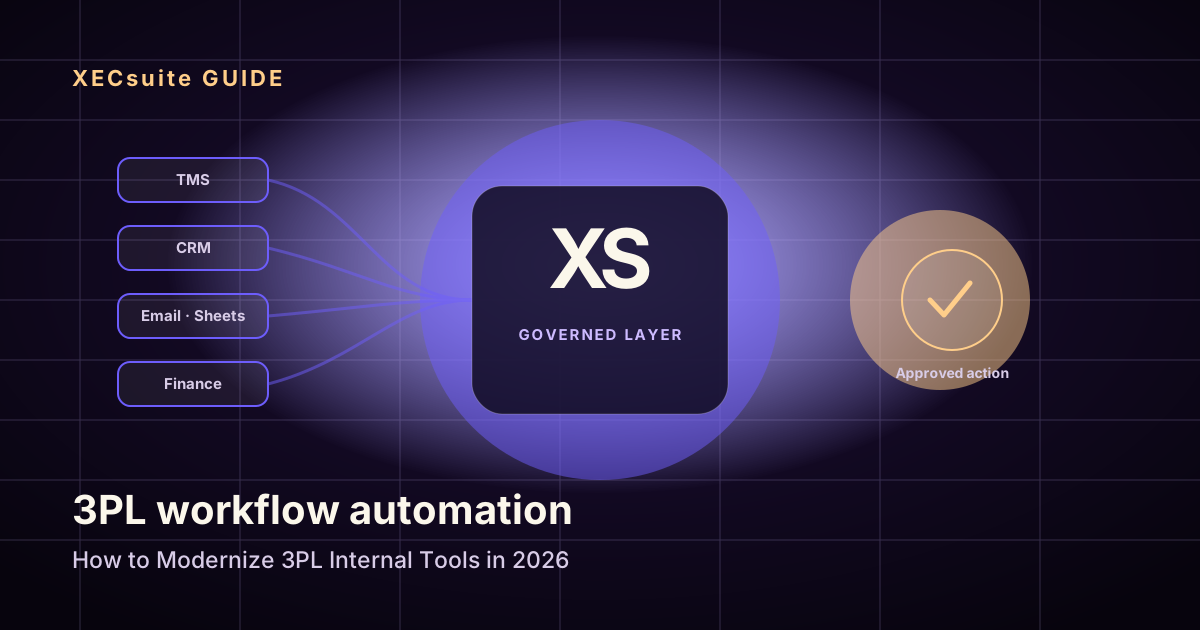
3PLs modernize internal tools by adding a governed AI operating layer above the existing TMS and back-office stack — an agent workforce that reads across systems, recommends the next move with evidence, and writes changes back through human approval gates.
The fastest way to modernize 3PL internal tools in 2026 is not to buy more software or rip out your TMS — it is to add a governed AI operating layer above the stack you already run. That layer puts an agent workforce on top of your TMS, CRM, inboxes, and spreadsheets, so it reads across all of them, recommends the next move with evidence attached, and writes changes back only after a human approves. The work gets done, not just dashboarded.
The failure mode in most cross-border 3PLs is not a tool shortage. It is tool sprawl: the TMS, CRM, quoting tools, and back-office spreadsheets each get smarter in isolation while staff still reconcile freight, customs, CRM, and cash by hand. Modernizing internal tooling means closing that gap — making the systems work as one governed operation instead of a dozen smart silos that never talk, so you can scale on revenue per employee instead of headcount.
What does it mean to modernize 3PL internal tools in 2026?
Modernizing internal tooling is not a software-buying exercise. Most cross-border Canada-US 3PLs already run a TMS, a CRM, accounting, Microsoft 365 or Google Workspace, a quoting workflow, and a stack of spreadsheets. The constraint is not capability — it is coordination. Every system holds part of the truth, and the people in the middle spend their days copying numbers between them.
The 2026 move is to add a layer above the stack that does the coordinating. Think of it as an operating layer: it connects to your existing systems, builds a tenant-private memory of your lanes, customers, rates, and SOPs, and runs an agent workforce that acts on that memory inside approval gates. It sits above the TMS and integrates with it — it does not replace your system of record.
The goal is fewer hand-offs between systems, not more screens.
Modernization is measured in decisions accelerated and hours recovered, not features shipped.
The existing TMS stays in place — the layer reads from and writes back to it.
Success looks like rising revenue per employee, not a bigger ops headcount.
Why does tool sprawl slow logistics decisions down?
Cross-border Canada-US freight is where sprawl hurts most. A single shipment can touch the TMS for execution, the CRM for the account, accounting for the invoice, email for the carrier thread, and a spreadsheet for the lane margin. When customs, FX, and dwell costs move, the signal is scattered across those systems and nobody sees it whole until margin has already eroded.
Each tool getting individually smarter makes this worse, not better, because the reconciliation work still lands on a coordinator. Every new point tool adds another surface to check. That is why adding operations headcount or an offshore back-office team is the status quo answer — and why it caps growth at a revenue-per-employee number that never improves.
Freight margin erodes between systems, not inside any one of them.
The reconciliation tax scales with headcount, so growth stays linear.
More tools without a coordinating layer means more swivel-chair work, not less.
The real alternatives owners reach for — more coordinators or offshore BPO — add cost without lifting revenue per employee.
What is a governed AI operating layer — and why above the TMS, not instead of it?
A governed AI operating layer is software plus an agent workforce that runs above your existing stack. Configurable modules — CRM, Marketing, Meeting Intelligence, Freight Analysis, Operations/SOP, and an Executive Assistant — are each wired into agents that read across your connected systems and a tenant-private company memory built from your own lanes, customers, rates, and SOPs.
Governed is the operative word. The AI drafts and recommends; humans approve before anything outbound or irreversible happens. Answers are source-backed with citations, confidence indicators, and freshness labels, so every meaningful output is marked as live, manual, demo, stale, or missing data. Tenant isolation is enforced at the database level with Postgres row-level security, and you own your data — exportable anytime in open formats, deleted on termination, never used to train models outside your private tenant.
It sits above the TMS on purpose. Your TMS is the system of record for execution; ripping it out is risk with no upside. The operating layer integrates with it — pulling context in, pushing approved changes back — so you modernize the operation without a migration project.
How do you map the work to real modules without overreaching?
The point of modules is to start where friction is highest and risk is lowest, then expand. Each maps to a concrete part of the operation, and each runs inside approval gates rather than autonomously.
Freight Analysis — lane, margin, and cost intelligence for cross-border CA-US freight; customs, FX, and dwell flags surfaced before they erode margin; source-backed recommendations on which lanes to re-rate.
Operations / SOP — your operating playbooks encoded so agents run the routine and route exceptions to the right person; SOPs ingested into company memory.
CRM — pipeline and cross-border accounts in one governed view; lead enrichment and dedupe; agent-drafted follow-up behind approval gates, so reps sell freight instead of maintaining records.
Meeting Intelligence — sales and ops calls captured, summarized, and turned into next actions pushed to the CRM and task lists, with a searchable history of customer commitments.
Marketing — agent-run lead-gen with list validation and dedupe against the CRM, campaigns built and enrolled with human approval, and attribution from outreach to booked revenue.
Executive Assistant — a chief-of-staff agent that briefs leadership across systems with prioritized decisions and evidence attached, drafts and reminders prepared behind approval.
How do you keep humans in control as you automate?
Automation without governance is how operations leaders get burned. XecSuite's design assumes the opposite: the AI is not autonomous. It drafts the email, scopes the re-rate, builds the campaign, prepares the brief — and a person approves before anything leaves the building or changes a record.
That control is reinforced by how answers are presented. Recommendations carry citations, a confidence indicator, and a freshness label, so an operations leader can see whether a recommendation rests on live data or a stale manual export before acting on it. For higher-stakes calls, the Advisory Council — specialist Finance, Sales/BD, Operations, Freight & Lane, and Customer agents — debates the tradeoffs using your connected data and company memory, then produces an evidence-backed recommendation with confidence and next steps for leadership to approve, defer, or escalate.
XecSuite brings company context and tools into the workflow under per-company budget controls. Confirm usage charges and licensing in the written scope.
How is this different from hiring more coordinators, offshore BPO, or a point tool?
This is the comparison that actually matters, and it is not against your TMS. XecSuite is not a TMS or a freight broker — it does not replace your system of record and it does not move freight or carry liability. The real status-quo alternative to modernizing internal tooling is adding operations headcount or standing up an offshore back-office team. Both add cost linearly and neither lifts revenue per employee.
The narrower AI point tools for logistics — products that automate carrier email, quoting, or document parsing — each handle one slice of the operation. XecSuite is the whole-operation layer those tools plug into. And horizontal Work AI assistants are general, per-seat, and built to answer across apps; XecSuite is vertical to cross-border 3PLs, acts rather than just answers, and is value-priced with no per-seat fee.
Versus more coordinators or offshore BPO — automate the reconciliation instead of staffing it; grow revenue per employee instead of headcount.
Versus a logistics point tool — keep it, and let the operating layer coordinate it with the rest of the stack rather than adding another silo.
Versus a general Work AI assistant — vertical to 3PLs, acts inside approval gates, and priced on value with no per-seat fee.
How do you prove the modernization worked?
Modernization only counts if it moves owner-level numbers. XecSuite frames return around four levers, baselined in the diagnostic and tracked by the platform as they move: owner and team hours recovered; decisions accelerated, measured as cycle time from question to approved action; software and tooling spend replaced; and margin and revenue protected, where customs, FX, dwell, at-risk accounts, and collections issues get surfaced before they become losses.
Be honest about proof. XecSuite has no published client results yet, and any ROI math is modeled, not observed — for example, a worked illustrative model of 6 hrs × ~$250/hr × 48 weeks ≈ $72,000 in modeled annual value recovered, where the ~$250/hr is illustrative and gets replaced by your own numbers in the diagnostic. An early engagement is already seeing efficiencies and cost savings acting on XecSuite recommendations. It is one anonymized, early signal — not a published case study — and exactly the kind of measurable proof every engagement is built to produce.
How to modernize 3PL internal tools with a governed operating layer
Inventory the stack and the decision bottlenecks. Map every system staff touch — TMS, CRM, accounting, email, quoting tools, spreadsheets — and mark where decisions stall because data lives in two places. The bottlenecks, not the tool count, are your modernization targets.
Pick the highest-friction, lowest-risk workflows first. Choose two or three workflows where reconciliation eats the most hours and a mistake is recoverable — lane margin review, follow-up after sales calls, or routine SOP exceptions. Start where value is high and blast radius is low.
Stand up tenant-private company memory. Build a private memory from your own lanes, customers, rates, and SOPs, isolated per tenant with Postgres row-level security. This is what makes recommendations specific to your operation instead of generic, and it stays exportable and owned by you.
Add the agent workforce module by module. Turn on modules against your real friction — Freight Analysis for margin and customs/FX/dwell flags, Operations/SOP for routine workflows, CRM and Meeting Intelligence for the sales side — starting on low-risk surfaces and expanding as trust builds.
Keep humans on the approval gates. Configure every outbound or irreversible action to require human approval. The AI drafts and recommends with citations, confidence, and freshness labels; your team approves. Nothing runs autonomously.
Integrate above the TMS, never replace it. Connect the layer to your system of record so it reads context in and writes approved changes back. Your TMS stays in place — you are adding a coordinating layer, not running a migration.
Measure against the four ROI levers. Baseline hours recovered, decision cycle time, tooling spend replaced, and margin protected in the diagnostic, then track movement on the platform. Expand to more modules only where the numbers justify it.
Key takeaways
The 3PL problem in 2026 is tool sprawl, not a tool shortage — modernization means coordinating the stack you have, not buying more or replacing the TMS.
A governed AI operating layer sits above the TMS: an agent workforce reads across systems, recommends with evidence, and writes back only through human approval gates.
The real alternative is added headcount or offshore BPO — both add cost without lifting revenue per employee; XecSuite is not a TMS or a broker, and it coordinates the point tools you already run.
Prove it against four levers: hours recovered, decisions accelerated, tooling spend replaced, and margin protected. Baseline them in a diagnostic, with no per-seat fees.
Frequently asked questions
How do 3PLs modernize internal tooling and workflow automation?
By adding a governed AI operating layer above the existing stack rather than buying more point tools or replacing the TMS. The layer runs an agent workforce that reads across the TMS, CRM, inboxes, and spreadsheets, recommends the next move with evidence, and writes approved changes back through human gates. You start on high-friction, low-risk workflows, stand up tenant-private company memory, add modules one at a time, and measure against hours recovered, decision speed, tooling spend replaced, and margin protected.
Is XecSuite a TMS, a freight broker, or something else?
Neither. XecSuite is not a TMS — it sits above your TMS and integrates with it rather than replacing the system of record. It is also not a freight broker, forwarder, or 4PL: it does not move freight or carry liability, because that business competes with our customers. XecSuite is a governed AI operating layer — software plus an agent workforce — built specifically for cross-border Canada-US 3PLs.
How does this compare to hiring more coordinators or using an offshore back-office team?
Adding operations headcount or an offshore BPO team is the status-quo alternative, and both add cost linearly without lifting revenue per employee. A governed operating layer automates the reconciliation work those people do today and keeps humans on the approval gates, so you scale output on revenue per employee instead of headcount. It also coordinates the logistics point tools and Work AI assistants you may already use, rather than adding another silo.
Does 3PL workflow automation mean replacing my TMS?
No. The operating layer sits above your TMS and integrates with it. Your TMS stays the system of record for execution; the layer pulls context from it and pushes approved changes back. Ripping out the system of record is risk with no upside — modernization here is additive, not a migration.
Is the automation autonomous, or do humans stay in control?
Humans stay in control. The AI drafts and recommends; a person approves before anything outbound or irreversible happens. Every meaningful output carries citations, a confidence indicator, and a freshness label so you can see whether a recommendation rests on live or stale data before acting. For higher-stakes calls, an Advisory Council of specialist agents debates the tradeoffs and produces an evidence-backed recommendation for leadership to approve, defer, or escalate.
How much does it cost to start, and are there per-seat fees?
There are no per-seat fees. Start with a diagnostic, then a 90-day pilot to prove the work. Pricing is set in a written proposal for your scope. Subscription is the platform plus the modules you switch on, priced on the value they create. Enterprise is custom, with dedicated capacity and sovereign Canadian hosting.
Want the operator version for your freight business?
Share your tool stack and the lane, decision, or workflow you are trying to fix. XecSuite will map the modules, agents, and workflow path that can produce measurable ROI.